Cleaning for project handover

Post Construction Cleaning Duluth

Cleanup that matches your build schedule: a rough pass once the trades wind down, a final clean for handover, then a touch-up after the punch list has been closed out.

✓Rough, final and touch-up ✓Works with your GC ✓Timed to the punch list
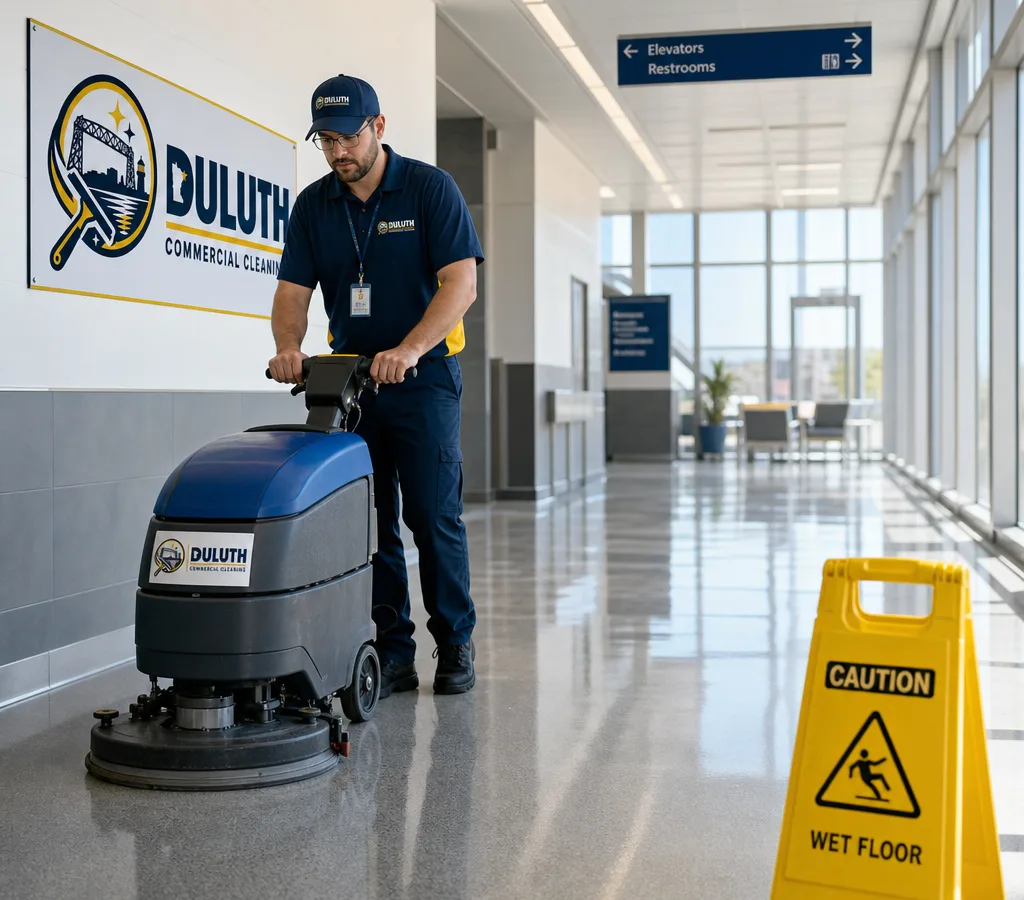
Technician performing commercial floor scrubbing in a large corridor with safety signage
Built around the schedule

Post construction cleaning Duluth projects can hand over on time

Drywall dust does not come out in one pass. It hangs in the air for hours, settles overnight on every surface that was just cleaned, and shows up again after the first HVAC cycle runs. Crews that clean once and leave get called back, usually on the morning of a client walkthrough, which is the one day nobody has spare hours.

Work is organized by phase instead of by room. A rough pass clears bulk debris and knocks down dust while trades are still finishing, the final clean details every surface for occupancy, and a touch-up pass catches whatever the punch list work put back. Adhesive, labels, paint specks and protective film each come off at the phase where that surface is genuinely done.

Coordination runs from our office at 26 E Superior St, Unit 4, so a date that slides two days, which it usually will, becomes a phone call rather than a lost slot. Phases can be booked together or separately, and a small tenant improvement is often one rough pass and one final rather than all three.
Check Availability
Phase by phase detail

What gets handled before a project is turned over

Drywall dust in repeat passes

Fine gypsum dust coats horizontal surfaces, then reappears from ledges, door tops and mechanical openings for days afterward. Removal uses vacuums with filtration rather than dry sweeping, working top down, with a second pass after the building has sat overnight and the air has cycled.

Adhesive, labels and stickers

Manufacturer labels on windows, fixtures, appliances and cabinets leave adhesive that hardens if it sits through a summer of sun. Removal uses solvents matched to each surface, so painted trim, anodized frames and laminate faces are not clouded or scratched in the process.

Paint specks and overspray

Spatter lands where nobody was looking: glass edges, hardware, switch plates, hinges, thresholds and the tops of door frames. Each speck comes off by hand using the method that surface tolerates, since a blade that is fine on glass will ruin a powder-coated frame.

Fixtures, frames and tracks

Light fixtures, diffusers, cabinet interiors, door frames, window frames and sliding tracks collect construction dust in exactly the spots a first walkthrough checks. Casework interiors are wiped out too, so the owner is not opening drawers full of sawdust on day one.

Touch-up after the punch list

Punch list work makes its own mess: a patched wall means sanding dust, a swapped fixture means fingerprints and packaging debris. A short touch-up pass once that work closes keeps the final walkthrough from finding the trades' leftovers instead of a finished building.

Check Availability
Projects that call us

Duluth construction projects that need cleaning before handover

Every project reaches a point where the building is finished and nobody can tell, because the dust is still on everything. What the cleanup looks like depends on what kind of project it was.

  • Tenant improvements: A suite rebuilt inside an occupied building has to be cleaned without carrying dust into the corridors and neighboring tenants. That means containment at the entry, negative pressure where available, and debris routed out along a path your property manager has approved.
  • New commercial builds: A building with no occupancy history needs every surface handled once, including the ones covered in protective film since spring. Film left on too long bonds to frames and glass, so it comes off before it turns into a warranty conversation with the installer.
  • Restaurant and retail buildouts: Fit-outs stack finishes into a small footprint, and the handover date is tied to an opening that has already been advertised. Casework interiors, stainless surfaces and fixture detail carry the most weight, because that is what a first customer actually looks at.
  • Renovations in occupied space: When one floor is under construction and the rest of the building is working, the cleanup schedule matters as much as the scope. Work happens after hours, with shared corridors and elevator lobbies cleaned nightly so the occupied side never inherits the project.

Bring the cleaner into the schedule conversation early, not at the end of it. The final clean needs the space to itself for a stretch, and when it gets squeezed between the last trade and the walkthrough, something gets skipped, usually the part the owner inspects first.

Check Availability
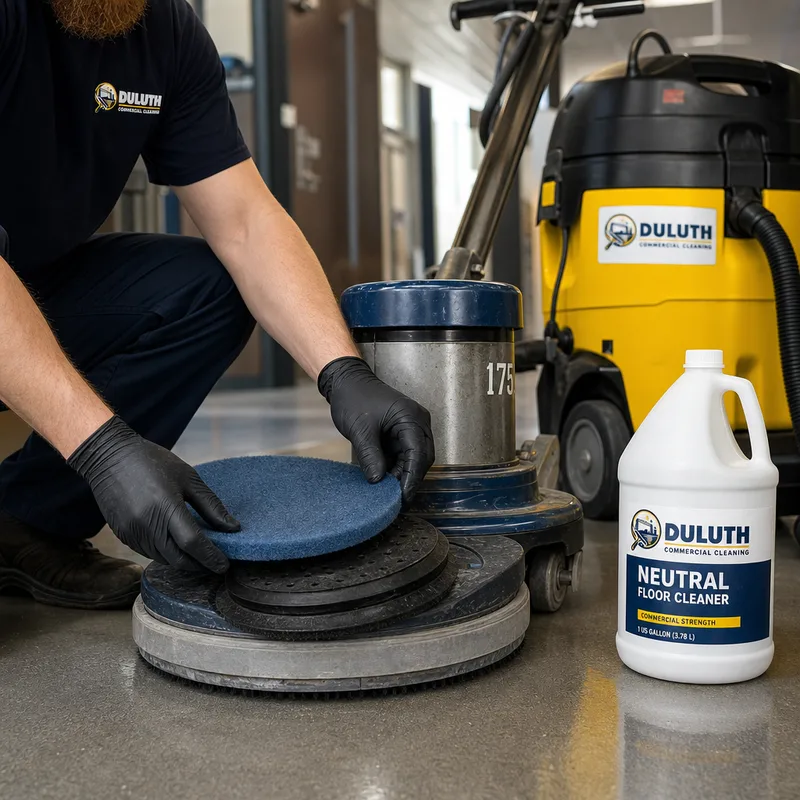
Floor technician changing pads on a low-speed floor machine beside labeled cleaning equipment
Phases on your calendar

How post construction cleaning is sequenced

Check Availability
01

Schedule review with the GC

Rough, final and touch-up get placed against your construction schedule in one sitting with the superintendent, along with which trades still have work left in the space. That conversation produces the realistic dates, since no clean can start before the ceilings are closed.

02

Rough clean during finishing

The rough pass runs while punch work continues: bulk debris out, surfaces knocked down, dust pulled off ledges and mechanical openings, and the space made workable for the trades still in it. It also shows what the final clean is dealing with before that date gets locked.

03

Final clean for occupancy

The final pass waits until trades are genuinely out, because one grinder undoes an afternoon of work. Every surface is detailed, labels and adhesive come off, frames and fixtures are cleaned, and the second dust pass happens after the building has sat overnight on its own.

04

Touch-up before walkthrough

The touch-up visit lands after punch list corrections close and before the owner walkthrough, sized to the actual rework rather than booked as a full day. Whatever turns up on that pass, such as a missed label or a fixture still wrapped, is handled while crews are there.

Construction cleanup budget

How Much Does Post Construction Cleaning Cost in Duluth, MN?

Post construction cleaning in Duluth typically ranges from $0.25 to $0.75 per square foot when all three phases are included, and roughly $0.15 to $0.35 per square foot for a final clean on its own. Smaller tenant improvement projects are often quoted flat instead, between about $800 and $3,000.

Phase count is the first driver, followed by how much finish detail the space carries: a warehouse shell and a medical fit-out of identical size are not comparable jobs. Ceiling height, glass quantity, casework, how long labels and film have been sitting there, and the firmness of the handover date all move it. Scope goes in writing, by phase, before pricing.

Check Availability
Questions from contractors

What general contractors ask about post construction cleaning

When should post construction cleaning be scheduled on our build?

Book the rough pass as finishes go in, the final clean once trades are genuinely done, and the touch-up after punch list corrections. Give the final clean a window of its own: sharing the space with an active trade is what produces a callback on walkthrough morning.

Why does drywall dust keep coming back after cleaning?

Because it stays airborne for hours and hides wherever air moves: ledges, door tops, ceiling grid, mechanical openings and the ductwork itself. That is why the final clean includes a second pass after the building has sat overnight and the system has run a cycle.

Can you work around our punch list crews?

Yes, and on most projects that is the only workable sequence. Crews clean the areas your punch list has already released and stay clear of the ones still active, with the touch-up pass sized later, once you know how much rework the list actually ended up generating.

Do you remove stickers and labels from new windows and fixtures?

Yes, label and adhesive removal is part of the final clean, with the solvent matched to each surface it touches. Flag anything that has been sitting in direct sun since spring, because old adhesive needs longer dwell time and must never be scraped off a coated frame.

Who supplies the dumpster and handles construction debris removal?

Bulk construction debris and dumpster service normally stay with the general contractor, and our crews bag material and carry it to the container you provide. Tell us what is on site before the rough pass, since hauling changes both the schedule and the price.

Is this different from a standard commercial cleaning visit?

Yes. A routine visit maintains a building that is already in use, while construction cleanup removes residue left by the build itself: gypsum dust, adhesive, paint specks and protective film. It runs in phases against a handover date instead of on a weekly schedule.

Get on the schedule

Get post construction cleaning scheduled against your handover date

Send us the square footage, the finish types, which phases you want covered, and the handover date you are working toward. We will walk the site with your superintendent, write the scope by phase, and hold dates that flex with the schedule instead of breaking when it slips.

Request a quote

Tell us about your facility

Send the details and we will arrange a walkthrough, then put a written scope in front of you before any work is scheduled.