Plant and warehouse cleaning

Industrial Cleaning Duluth

Cleaning crews for working buildings: dust on high steel, grease around equipment, residue packed into traffic lanes, handled around your production schedule instead of stopping it.

✓Around production shifts ✓High-bay and mezzanine work ✓Dock and lane cleaning
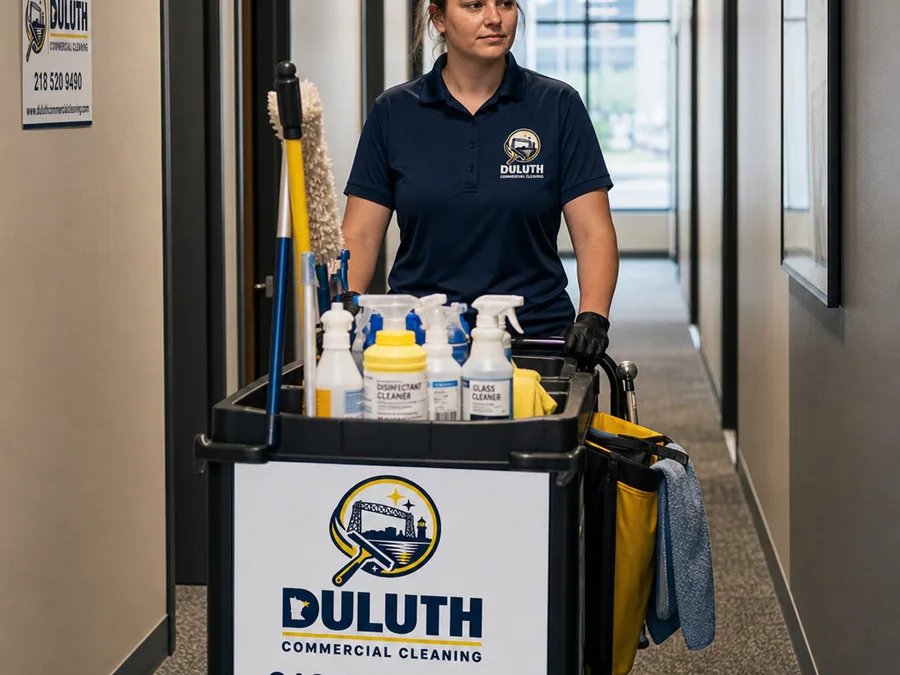
Uniformed janitorial technician moving organized cleaning tools through a commercial hallway
Working around production

Industrial cleaning Duluth plants can schedule without stopping work

Dust does not stay where it is made. It rides the air handlers onto beams, light fixtures and the tops of racking, then drops back onto finished goods weeks later. Grease creeps out from under equipment into walking lanes. By the time an industrial building looks dirty, most of the buildup is already somewhere a mop will never reach.

Industrial work here covers warehouse floors and racking, manufacturing bays, machine shop surfaces, food processing rooms, high-bay steel, mezzanine decks, loading docks and the forklift lanes that wear first. Methods change with the residue: dry collection for fine particulate, degreasers for oil film, and containment whenever a clean area sits next to a running line.

Crews dispatch from 26 E Superior St, Unit 4, close enough to the industrial corridor that a shutdown window opening at six on a Sunday is workable. Cadence depends on the building: quarterly overhead dusting for some plants, monthly lane and dock work, or one full reset a year during a planned outage.
Check Availability
Industrial scope by area

Where an industrial cleaning crew spends its time

High-bay and overhead dusting

Above about fifteen feet, dust sits on joists, conduit, sprinkler lines, light fixtures and the top deck of racking until something disturbs it. Crews work from lifts with collection at the source, so the load leaves the building instead of relocating to the floor underneath.

Production floor and equipment surrounds

Around presses, mixers, saws and conveyors, residue builds in the places daily housekeeping skips: equipment bases, guard rails, pedestals, cable trays and the floor seams beneath them. Work stays on the exterior of machinery and inside the zones your maintenance lead has released.

Grease, oil and coolant residue

In machine shops and processing rooms, oil film mixes with airborne dust into a layer that turns walking surfaces slick. Degreasing works through dwell time and agitation rather than pressure, with recovery captured so nothing runs toward a floor drain it should not enter.

Docks, lanes and staging areas

At the dock, salt, road grit, shrink wrap fragments and pallet debris collect in the door tracks and the first stretch of concrete inside. Forklift lanes hold tire marks and compacted soil, so those runs are cleaned on a tighter interval than open storage ever needs.

Mezzanines, catwalks and racking

On elevated decks and catwalks, grating, kick plates and handrails hold dust that falls straight onto whatever sits below. Racking uprights, beams and the tops of stored cases are worked from the top down, so the same debris does not get handled twice in one visit.

Check Availability
Industrial buildings we enter

Duluth industrial sites that need more than routine housekeeping

An in-house crew usually handles daily housekeeping well enough. What piles up is everything that needs lifts, degreasers, containment, or a window when the line is down.

  • Warehouses and distribution: High racking, long lanes and constant forklift traffic create a dust profile that sits high and a soil profile that sits in the wheel paths. Both need equipment an in-house crew rarely owns, and both get worse quietly for months at a time.
  • Manufacturing floors: Fine particulate from cutting, grinding or packaging settles on every horizontal surface in the building, including the ones directly above the line. Scheduled overhead work keeps it out of product and out of a fire-code conversation later on.
  • Machine shops: Oil mist, coolant spray and metal fines combine into a film that coats floors, walls and equipment bases. Degreasing at a set interval keeps traction where operators stand and keeps chips from being tracked through the rest of the shop.
  • Food processing rooms: Production areas need cleaning that respects your sanitation program instead of working around it. Crews handle nonproduct-contact surfaces, walls, drain surrounds and overhead structures on your schedule, with your quality lead setting the boundaries.

Ask any industrial cleaning bidder two things: what equipment they are bringing, and who on your side signs off on access. A crew that turns up with mops for an overhead dusting job burns a shutdown window you cannot get back, and that window is usually the expensive part of the job.

Check Availability
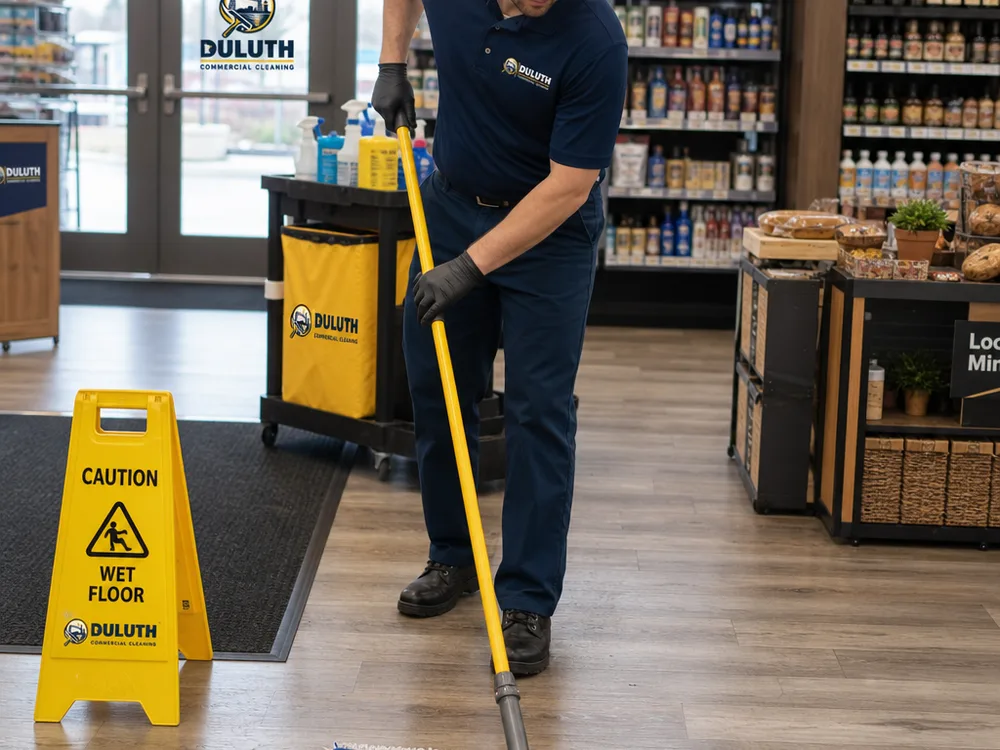
Cleaner performing commercial floor care with a microfiber flat mop in a retail aisle
How a plant job runs

Our approach to industrial cleaning work

Check Availability
01

Site walk with maintenance

Before anything is quoted, we walk the floor with your maintenance or plant lead to see the residue, the reach and the restrictions. Restricted areas, lockout zones and anything your team has to isolate are marked on that walk rather than discovered by a crew at eleven at night.

02

Scope tied to your window

Once the available window is known, the scope is built to fit inside it: what can be done during a running shift, what needs the line down, and what should wait for the next planned outage. Each task lists its method and equipment, so there is no debate later about who brings the lift.

03

Access, PPE and coordination

While crews are on site they follow your plant rules on PPE, traffic routes and sign-in, and they work only inside zones your team has released. One point of contact on each side handles anything unexpected, such as a spill found under a conveyor or a barricade that has been moved.

04

Work, verify, hand back

After the work finishes, the area is walked with your lead before crews leave, so rework happens inside the same window instead of next month. Anything worth knowing, like a leak under equipment or a drain backing up, goes to you in writing the same night it is found.

What industrial work costs

How Much Does Industrial Cleaning Cost in Duluth, MN?

Industrial cleaning in Duluth typically ranges from $0.12 to $0.40 per square foot for a scheduled clean, while a full reset during a shutdown commonly runs $1,500 to $9,000 depending on building size and how long the area has gone without attention. Overhead dusting and degreasing sit at the upper end, because both need lift time.

Equipment is the largest variable: lift rentals, scrubbers, vacuums with filtration, and the crew size needed to finish inside a fixed window. Residue type, ceiling height, whether production keeps running and any disposal requirements all change the figure as well. We walk the site and issue a written scope, with the method named per area, before a number goes on paper.

Check Availability
Plant floor questions

What plant and warehouse managers ask about industrial cleaning

Can you clean while our production line keeps running?

Often yes, using containment and zone-by-zone scheduling so crews never share space with a running machine. Overhead work above an active line is the usual exception: that generally needs the equipment down, which is why it gets grouped into a shutdown window instead.

Do your crews follow our PPE and lockout rules?

Crews work to your site rules, wear the PPE each area requires, sign in through your process, and stay out of any zone your team has not released. Your maintenance lead owns isolation and lockout, and we treat those boundaries as fixed facts to coordinate around.

How often should a warehouse get overhead dusting?

Quarterly to annually covers most buildings, driven by what the operation generates. A packaging or milling operation loads overhead surfaces far faster than pure storage does, and if you can see fuzz on sprinkler heads or conduit, the interval has already been stretched.

Can you work a weekend shutdown or a holiday window?

Weekend and holiday windows are normal for this work, and they are usually the cheapest way to buy it, because crews can run at full speed with no production around them. Tell us the window edges early: the scope gets sized to finish inside it rather than leaving half a bay done.

What do you do about grease near floor drains?

Degreasing is done with recovery rather than flushing, so residue is collected instead of pushed toward a drain. If your facility has discharge limits or an interceptor to protect, say so on the walk and the method for that area is written specifically to match.

How is industrial cleaning different from a janitorial service contract?

Janitorial work is the recurring routine that keeps offices, restrooms and break areas at a steady condition on a fixed cadence. Industrial cleaning targets the residue a production building creates, needs lifts and degreasing equipment, and is scheduled around shifts or a shutdown rather than nightly.

Book a plant walk

Walk your plant with us and get an industrial cleaning scope

Tell us what your building makes or moves, the ceiling height, the residue you are fighting, and the windows you can offer us. We will walk the site with your maintenance lead, write the scope area by area with methods and equipment named, and price it to finish inside that window.

Request a quote

Tell us about your facility

Send the details and we will arrange a walkthrough, then put a written scope in front of you before any work is scheduled.